
Divided We Stand
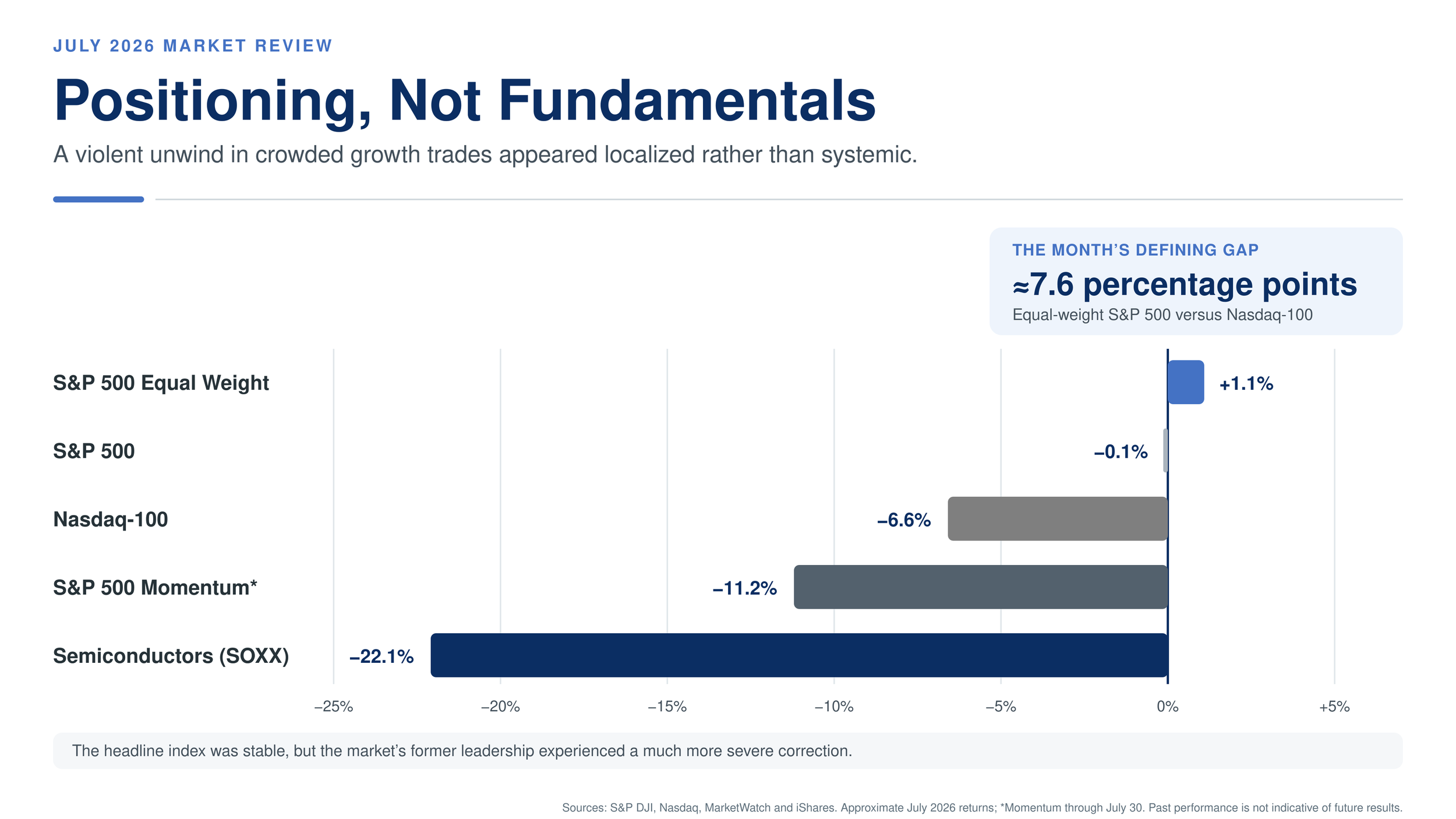
Markets were sharply divided in July as a ferocious unwind in crowded growth trades shook the Nasdaq 100 index (-6.6% July) while offsetting strength in other areas left the S&P 500 (-0.1% July) mostly unscathed.
Underscoring the month’s wide dispersion, while the S&P 500 Equal Weight Index touched record highs in July with a gain of 1.1%, the S&P 500 Momentum Index fell more than 11% (chart). Similarly, while semiconductors were particularly weak—the SOXX ETF fell approximately 22% for the full month—software, financials, energy and other less-crowded areas provided important offsets. The end result looked more like a rotation away from crowded exposures than an indiscriminate flight from equities.
July’s nearly flat S&P 500 masked a sharp unwind in crowded growth trades. Equal-weight stocks held firm while the Nasdaq-100, momentum and semiconductors fell sharply, suggesting the selling remained concentrated rather than systemic.
Reinforcing the divided picture, economic data during the month was mixed as June headline CPI declined 0.4% on falling energy prices, but year-over-year inflation remained firm at 3.5%. Meanwhile, second-quarter real GDP grew at a 1.5% annualized rate, down from 2.1% in the first quarter, while the PCE price index accelerated to 5.1%. Against that backdrop, the Federal Reserve left its target range unchanged at 3.50%–3.75% with three members dissenting in favor of a quarter-point increase, leaving markets to balance slower growth, rising long-term bond yields and questions about whether the scale of AI investment will translate into durable earnings.
July’s technology reversal also took on a market-structure dimension late in the month, when Situational Awareness was forced to sell much of its public-equity portfolio amid margin pressure. The episode, examined below, appears to have intensified selling in several crowded AI-related positions.
As the localized, positioning-driven equity weakness did not trigger signs of systemic stress in the Volatility Dashboard, TCM Risk Managed Equities strategies used the dip to increase exposure in July, ending the month with net notional equity exposure near 107% while S&P 500 Equal Weight positioning allowed Alpha Seeker to sidestep the drama in tech and finish 1% higher on the month.
Despite pockets of equity weakness during July, TCM’s Volatility Dashboard remained broadly constructive and did not indicate that the stress was becoming systemic. Dashboard as of July 31, 2026. Source: TCM. Click for larger image
A fundamental Misunderstanding
July provided a particularly visible example of how leverage can turn an ordinary reversal into forced selling that is distinct from a true market-wide crisis. With roughly $20 billion in assets, the Situational Awareness fund entered the month with concentrated AI positions and reportedly carried gross exposure approaching four times investor capital. As several positions moved sharply against the fund, leverage magnified the losses while margin requirements tightened, ultimately forcing the fund to sell most of its public-equity portfolio to Citadel at a steep discount by July 30th. Though it created steep share price declines, the episode did not necessarily indicate that the long-term prospects of every affected company had deteriorated by the same magnitude.
This is the basic mechanism behind deleveraging and de-grossing. Losses in crowded positions reduce available capital; risk limits and prime-broker requirements then force investors to cut both long and short exposure. Those transactions can create additional selling pressure, higher correlations and unusually large price moves. What’s more, because fundamentals can take a back seat during forced deleveraging, prices may rebound rapidly once the selling subsides and the temporary imbalance between buyers and sellers clears—as several AI-related stocks did following the Situational Awareness transaction.
Forced deleveraging can produce selling that reflects portfolio mechanics and risk constraints more than a fresh reassessment of underlying fundamentals.
In our view, this distinction is important for tactical hedging because positioning-driven selloffs do not always evolve into broad left-tail events and may reverse sharply once forced activity subsides. During July, though technology volatility rose sharply, the S&P 500 remained comparatively resilient with the VIX rising only briefly above 20 and most importantly, without an inversion in the VIX futures curve that often accompanies market crisis periods. Because those signals had not emerged, TCM strategies increased equity exposure as prices weakened rather than adding hedges, positioning the portfolios to participate more fully in the early-August rebound.
This is not to suggest that the episode was without risk, only that it showed no clear signs of spreading into a broader market crisis. Had VIX remained elevated and the VIX futures curve inverted across multiple maturities, the resulting evidence of systemic stress would have supported a different portfolio response.
The objective is not to discount the risks of forced selling, but to distinguish temporary market mechanics from conditions that may call for a more substantial defensive posture. That distinction necessarily involves trade-offs. Waiting for confirmation may leave a portfolio exposed to the early stages of a decline, while protection added as risk rises can occasionally incur a modest insurance cost if conditions then stabilize. In our view, however, maintaining protection continuously presents a more persistent challenge: the drag created during the much longer periods in which equities rise amid normal volatility.
The goal is not to outperform during every correction. Rather, it is to participate meaningfully in rising markets while retaining a responsive defense when evidence of left-tail risk materially strengthens. Applied consistently, we believe this approach offers a more balanced path that helps investors stay the course through full market cycles.